

How do different books of Bulgarian Folk Tales compare?
There are a number of different published collections of Bulgarian folk tales that are available today, and choosing which book is the best for you can be difficult. I love folk tales from Bulgaria, and I have been reading and listening to Bulgarian folk tales for over 25 years. This article is not a review of the books featured here, instead it is an informed analysis of five of the currently available books that get listed in search results for the search term Bulgarian Folk Tales, based on the following criteria:
OVERVIEW: The audience that the books are aimed at, and how many folk tales are included.
SOURCE TEXTS AND APPEAL: Where the tales come from, and who they will appeal to.
REVIEWS: What independent reviewers have said about the books.
ILLUSTRATIONS: What illustrations are included in the books.
RESOURCES: What background material is included in the books, and its significance.
I hope that my following analysis will be helpful for those people that are looking to buy a book of Bulgarian folk tales for themselves or for someone else.
INTRODUCTION:
Books of Bulgarian folk tales can be divided into those that are aimed at children (sometimes called “family friendly”) and those that are aimed at adults. You can expect that books aimed at younger readers will not include tales that contain themes that may be upsetting for children, like death, violence or horror. Books that are aimed at adults may also contain a few tales that are suitable for children, but will predominantly contain material that appeals to readers that enjoy more sophisticated, exciting, thrilling tales with an emotional breadth that makes them deeply satisfying.
Collections of folk tales may also contain resources presented as background information about the tales. It is in the nature of folk tales that they contain folk wisdom going back hundreds or even thousands of years. They contain symbols and archetypes that are very primal, and it is a highly enriching experience for an adult reader to be able to explore and understand their roots and the deeper meanings that are preserved in authentic folk tales.
Bulgarian folk tales share elements of many European folk tales. It should be mentioned that all collections of folk tales published in book form owe their existence to pioneering authors such as Giovanni Francesco Straparola (1485–1558), Giambattista Basile (1566–1632), Charles Perrault (1628-1703) and the Brothers Grimm (circa 1785-1863). Before these tales were ever written down, they belonged exclusively to the realm of traditional oral storytelling. The term Bulgarian Folk Tales is used to describe only one element of a larger oral tradition from which the original authentic storytelling material comes. Within the Bulgarian oral tradition there are story forms called myths, epics, ballads, songs, legends and wonder tales (also known as fairy tales). At the time of writing, there is only one book available in English that contains examples of all of these forms.
A FOCUSED COMPARISON ANALYSIS OF BULGARIAN FOLK TALES BOOKS:
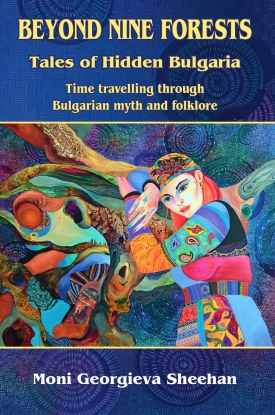
“Beyond Nine Forests: Tales of Hidden Bulgaria” by Moni Georgieva Sheehan (Paraskeva Publishing)
OVERVIEW: “Beyond Nine Forests: Tales of Hidden Bulgaria” is aimed at adults and contains 54 tales consisting of folk tales, myths, epics, ballads, songs, legends and wonder tales. So, technically, this book may be described as more than a book of Bulgarian Folk Tales because it contains examples of many different forms of Bulgarian traditional tale in addition to the folk tales themselves.
SOURCE TEXTS AND APPEAL: The original Bulgarian sources cited for the tales in “Beyond Nine Forests: Tales of Hidden Bulgaria” are primarily old, rare, out-of-print books of authentic material and often include fascinating details of the precise village, and sometimes the age, and profession, of the exact person that a tale was directly collected first-hand orally from. The original source texts in this book were translated by hand by the author and her mother over a period of 30 years. The fact that the source texts are authentic written versions of Bulgarian orally transmitted tales, along with the broad spectrum of story forms (folk tales, myths, epics, ballads, songs, legends and wonder tales), means that this book will appeal to folk tale lovers and enthusiasts who appreciate less well known, rare and precious material, with great emotional depth and sophistication.
REVIEWS: Independent reviews of “Beyond Nine Forests: Tales of Hidden Bulgaria” have described the book as “mindblowingly fabulous” and the stories as “exemplary texts” and “deeply satisfying” (Ben Haggarty, amazon.co.uk) and of how the author uses “eloquent, flowing language that makes them come alive off the page” (Csenge Virag Zalka, goodreads.com)
ILLUSTRATIONS: The illustrations in “Beyond Nine Forests: Tales of Hidden Bulgaria” are beautifully reproduced in full colour and include selected artworks by respected Bulgarian artists including Silvia Pavlova, Keazim Issinov, Ivan Milev, Virginia Stoyanova, Nelly Tsenova, Valeri Tsenov, Lilyana Dvoryanova and Maria Ilieva, along with contributions from Georgi Mishev and Ivan Mrkvichka. The illustrations will appeal to lovers of fine art and beautiful paintings.
RESOURCES: “Beyond Nine Forests: Tales of Hidden Bulgaria” includes a considerable amount of background information about the ancient Thracians, the Slavs and the Bulgars who were the ancestral peoples that inhabited the lands now known as Bulgaria. A large amount of in-depth information about Bulgarian folklore is included along with a detailed summation of the festivals and customs that make up the calendar of the Bulgarian ritual year. This information will appeal to adult readers who want a rich experience, a deeper understanding of folk tales, and who want to appreciate and understand the roots, symbols and archetypes contained within them.
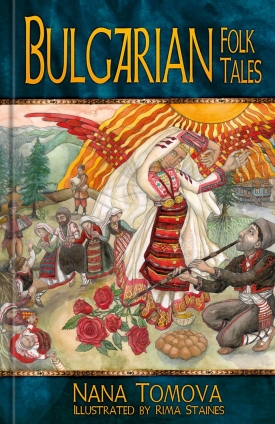
“Bulgarian Folk Tales” by Nana Tomova (The History Press)
OVERVIEW: The book “Bulgarian Folk Tales” is publicised by the author as suitable for children aged 9 years and upwards. This book contains 31 folk tales.
SOURCE TEXTS AND APPEAL: The original Bulgarian sources cited for the tales in the book “Bulgarian Folk Tales”, with the exception of one story, are modern compilations of popular stories for children, or retellings by established Bulgarian authors aimed at younger readers. As such, tales in this book are not from authentic original root sources, and the themes and motifs in them have already been altered by others to suit children. One incidence of mild violence, and one of animal cruelty, is clearly highlighted by the author so that a parent can decide if a tale may be unsuitable for telling to their own child. Because the tales in this book come from the author’s own translations of already well known Bulgarian folk tales for children, this book will appeal more to readers that have no previous knowledge of Bulgarian folk tales and who desire stories with a simple, less sophisticated storyline.
REVIEWS: There are no independent reviews of “Bulgarian Folk Tales” at the time of writing.
ILLUSTRATIONS: The illustrations in the book “Bulgarian Folk Tales” are simple line drawings by Rima Staines, and are printed in black and white. The simplicity of the illustrations will appeal to younger readers.
RESOURCES: In the background information for “Bulgarian Folk Tales” the author interprets the tales from a feminist standpoint and mentions the human impact on the environment along with some descriptions of folk customs. This background information will appeal to readers who are interested in feminism and environmental issues, but may not be suitable for all readers.
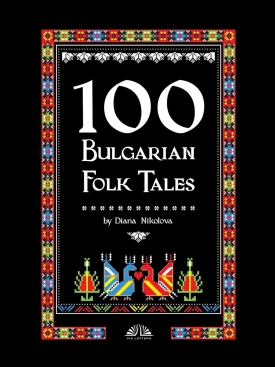
“100 Bulgarian Folk Tales” by Diana Nikolova (Via Lettera Ltd.)
OVERVIEW: “100 Bulgarian Folk Tales” is a large collection of Bulgarian folk tales that is categorised as being suitable for children. The book contains 100 folk tales.
SOURCE TEXTS AND APPEAL: The original Bulgarian source texts for “100 Bulgarian Folk Tales” are not cited. The author says that reading “100 Bulgarian Folk Tales” will make you “relax” and invites its readers to travel back to a time when you could spend “a cosy evening by the fireplace with your beloved elders”. The tales are told with a warmth and intimacy, in a compact and concise way, which means that “100 Bulgarian Folk Tales” will appeal to readers that enjoy a wide variety of Bulgarian folk tales that are easy to read, and desire stories with a straightforward approach.
REVIEWS: There are no independent reviews of “100 Bulgarian Folk Tales” at the time of writing.
ILLUSTRATIONS: There are no illustrations in “100 Bulgarian Folk Tales”.
RESOURCES: There is a small amount of background information to the tales in “100 Bulgarian Folk Tales”, and where it is included it is incorporated into the individual tales rather than written as a separate prelude or chapter. This approach makes any background information behind a story less formal and the tales will appeal to readers who enjoy folk tales told in a more conversational manner.
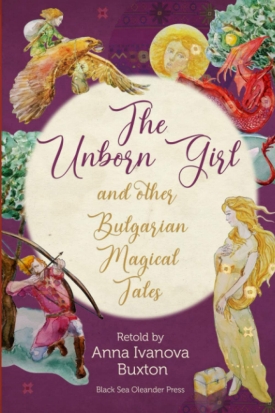
“The Unborn Girl and other Bulgarian Magical Tales” by Anna Ivanova Buxton (Black Sea Oleander Press)
OVERVIEW: “The Unborn Girl and other Bulgarian Magical Tales” is aimed at children, however extensive commentaries on the stories are included for adult readers. The book contains 20 folk tales.
SOURCE TEXTS AND APPEAL: The original Bulgarian sources cited by the author for the tales in “The Unborn Girl and other Bulgarian Magical Tales” are primarily authentic stories collected from Bulgarian villages in the 18th and 19th Centuries. The commentaries state the village or region that some of the tales have come from. The fact that the source texts are authentic written versions of Bulgarian orally transmitted tales, means this book will appeal to parents, guardians or teachers who want young readers to know and appreciate less well known, rare and precious material.
REVIEWS: Independent reviews of “The Unborn Girl and other Bulgarian Magical Tales” have described the tales as “full of wisdom, magic and humanity” (Teodora Aldridge, amazon.co.uk) and “Magical!!!” (Maria A Riley, amazon.co.uk)
ILLUSTRATIONS: The illustrations in the book “The Unborn Girl and other Bulgarian Magical Tales” are by Ivelina Nikolova, painted in watercolours and reproduced either in full colour or in black and white. The artworks depict scenes from the tales, and the illustrations will appeal to young readers and adults who appreciate beautiful paintings.
RESOURCES: “The Unborn Girl and other Bulgarian Magical Tales” includes commentaries on each tale in the book, plus an afterword (postscript) which offers a detailed analysis of the material. This information will appeal to parents, guardians or teachers of young readers who want to give them a deeper understanding of the folk tales, and who want to be able to discuss with them the roots, symbols and archetypes contained within the tales.
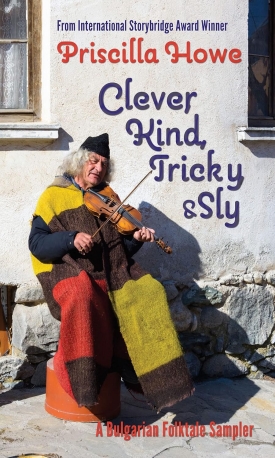
“Clever, Kind, Tricky, and Sly: A Bulgarian Folktale Sampler” by Pricilla Howe (Parkhurst Brothers Publishers Inc)
OVERVIEW: “Clever, Kind, Tricky, and Sly: A Bulgarian Folktale Sampler” is a collection of Bulgarian folk tales that is categorised as being suitable for children. The book contains 43 folk tales.
SOURCE TEXTS AND APPEAL: The original Bulgarian source texts for “Clever, Kind, Tricky, and Sly: A Bulgarian Folktale Sampler” are all cited in great detail. The author has researched the archives of the Bulgarian Institute of Ethnology and Folklore Studies with Ethnographic Museum (IEFSEM) in Sofia, and the House of Humour and Satire in Gabrovo, which means that the sources are authentic and original. Many of the tales in “Clever, Kind, Tricky, and Sly: A Bulgarian Folktale Sampler” are very humorous and nearly all are quite short. The author tells the tales in a compact and concise way, which means that this book will appeal to readers, teachers and storytellers who enjoy light-hearted Bulgarian folk tales that are amusing, easy to read and easy to remember.
REVIEWS: Independent reviews of “Clever, Kind, Tricky, and Sly: A Bulgarian Folktale Sampler” describe the book as “an absolute delight” and an “important contribution to storytelling literature” (Beth Horner), along with “Captivating, international, inviting, and unique” (Sean Buvala).
ILLUSTRATIONS: There are small illustrations in “Clever, Kind, Tricky, and Sly: A Bulgarian Folktale Sampler”. The illustrations are line drawings in black and white
RESOURCES: The author includes entertaining anecdotes before each of the tales in “Clever, Kind, Tricky, and Sly: A Bulgarian Folktale Sampler”, along with “Storyteller’s Notes” after each story. The notes are written to give guidance to teachers and storytellers about how to tell the tales and their typical target audiences. This information makes this book appeal to readers who enjoy short light-hearted folk tales, and also to teachers and storytellers who want to retell the stories themselves to other people.
“Bulgarian Mythology and Legends: Journey Through Time With Myths and Folklore” by Chronicle Press (Published by the author)
OVERVIEW: “Bulgarian Mythology and Legends: Journey Through Time With Myths and Folklore” claims to be a collection of Bulgarian myths and is not categorised as being suitable for adults or children. The book contents list appears to show that it contains 10 tales.
SOURCE TEXTS AND APPEAL: The original Bulgarian source texts for “Bulgarian Mythology and Legends: Journey Through Time With Myths and Folklore” are not cited. The author invites readers to “go on a voyage that is genuinely extraordinary”. The book “Bulgarian Mythology and Legends: Journey Through Time With Myths and Folklore” may get listed in online search results for Bulgarian folk tales, however it does not actually contain any tales or myths, and is merely an essay about characters in Bulgarian myth and folklore. This book will not appeal to readers that are looking for Bulgarian myth and folklore or folk tales.
REVIEWS: Independent reviews of “Bulgarian Mythology and Legends: Journey Through Time With Myths and Folklore” criticise the book as “Badly written” (Gloria Y, amazon.co.uk) and “Super disappointing. Waste of money” (Juliette Watier, amazon.co.uk)
ILLUSTRATIONS: There are no illustrations in the book “Bulgarian Mythology and Legends: Journey Through Time With Myths and Folklore”
RESOURCES: The book “Bulgarian Mythology and Legends: Journey Through Time With Myths and Folklore” is essentially only background information about folk tales, but without the tales themselves. There are also many errors in the information presented. Because of this, the book will not appeal to readers that are looking for information about Bulgarian folk tales or for the tales themselves.